 English
Views: 200 Author: DEYUAN 041 Publish Time: 2026-11-18 Origin: Site

As an elastic compensation component, expansion joints feature reliable operation, excellent performance, and a compact structure. They are widely used in foundational engineering fields such as chemical processing, construction, water supply, drainage, petroleum, light and heavy industries, refrigeration, sanitation, plumbing, fire protection, and electric power, playing a vital role in people's daily lives.
Commonly referred to as a compensator, an expansion joint is a flexible structure installed on vessel shells or pipelines to compensate for additional stress caused by temperature differentials and mechanical vibrations. Expansion joints are classified into two main types: metallic expansion joints and non-metallic expansion joints.
Below is a comparison of the performance characteristics between metallic and non-metallic expansion joints to provide a deeper understanding.
1. Compensation Capacity
Under the same dimensions, the compensation capacity of non-metallic expansion joints is significantly greater than that of metallic ones. This is especially true for lateral displacement compensation, where the capacity of non-metallic expansion joints can be nearly an order of magnitude larger than that of metallic expansion joints.
2. Compensation Resistance
An expansion joint acts like an elastomer, generating resistance after being compressed or stretched. The resistance of metallic expansion joints is much greater than that of non-metallic ones. Excessive resistance is detrimental to the system, as it can push against and damage surrounding equipment.
3. High-Temperature and Corrosion Resistance
The materials used in non-metallic expansion joints offer not only excellent high-temperature resistance but also superb resistance to acids and alkalis. The yield limit of ordinary carbon structural steel drops to zero in a 600°C environment, and it oxidizes and scales at higher temperatures. Carbon steel expansion joints are prone to cracking during operation, while stainless steel expansion joints can suffer from dew-point corrosion in low-temperature environments, and their manufacturing costs are considerable.
4. Thermal Insulation and Energy Efficiency
The inherent structure of a non-metallic expansion joint provides thermal insulation performance. Metallic expansion joints lack this characteristic and require an extra external insulation layer to retain heat.
5. Maintenance and Replacement Convenience
Non-metallic expansion joints require zero maintenance during their normal service life cycle. Furthermore, replacing a non-metallic expansion joint is much more convenient than replacing a metallic one.
6. Service Life
The service life of an expansion joint is closely tied to environmental conditions. Non-metallic expansion joints possess superior wear and corrosion resistance. Relatively speaking, under identical conditions, the lifespan of a non-metallic expansion joint is longer than that of a metallic one.
7. Operating Pressure
Benefiting from their flexible design and the special materials used, non-metallic expansion joints can withstand higher operating pressures.
8. Applicable Media
Metallic expansion joints are suitable for liquids, gases, and powders. Non-metallic expansion joints can handle both gases and liquids.
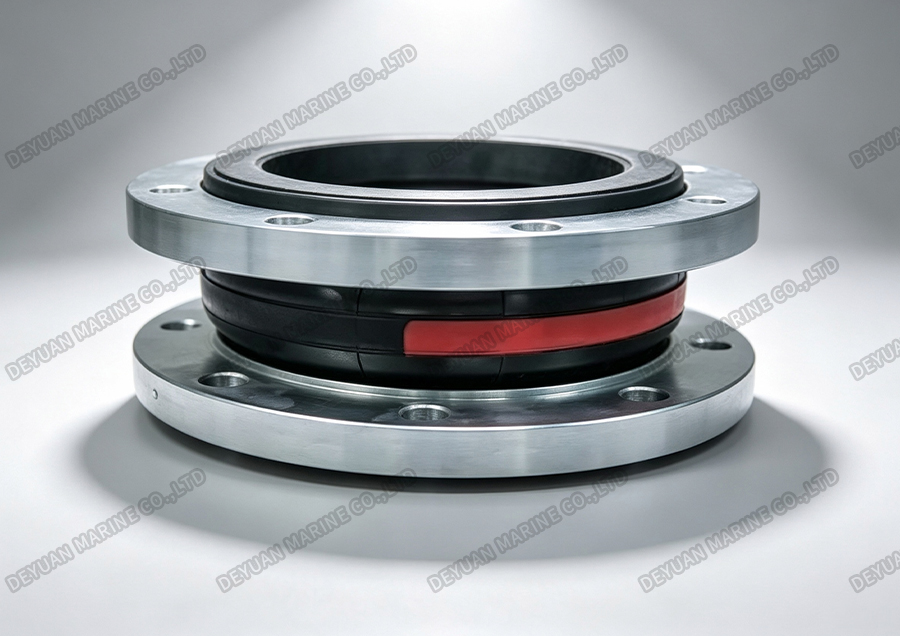
As an important category of non-metallic expansion joints, rubber expansion joints offer large displacement compensation capabilities. They can compensate for axial, lateral, and angular displacements while reducing noise, dampening vibrations, and providing a certain degree of corrosion resistance.
In marine applications, rubber expansion joints are generally used for water and oil pipelines. For exhaust systems, metallic expansion joints are used, as the exhaust gas temperature far exceeds what rubber can withstand.
I can help format this text into a bilingual comparison table or standard technical document layout if needed. Would you like me to make any adjustments to specific technical terminology?