
 English
 Views: 168 Author: DEYUAN 041 Publish Time: 2026-07-13 Origin: Site

As the International Maritime Organization (IMO) continues to raise standards for marine environmental protection, bilge water discharge management has become a critical component of vessel pollution prevention. Under MARPOL Annex I, Regulation 14, all vessels of 400 gross tonnage and above must be fitted with oil filtering equipment to ensure that the oil content of treated effluent does not exceed 15ppm.
Our marine Oily Water Separators, is covering the DY Series standard models and HCS Series high-capacity models, providing reliable and compliant bilge water treatment solutions for shipowners worldwide.
1. Product Overview
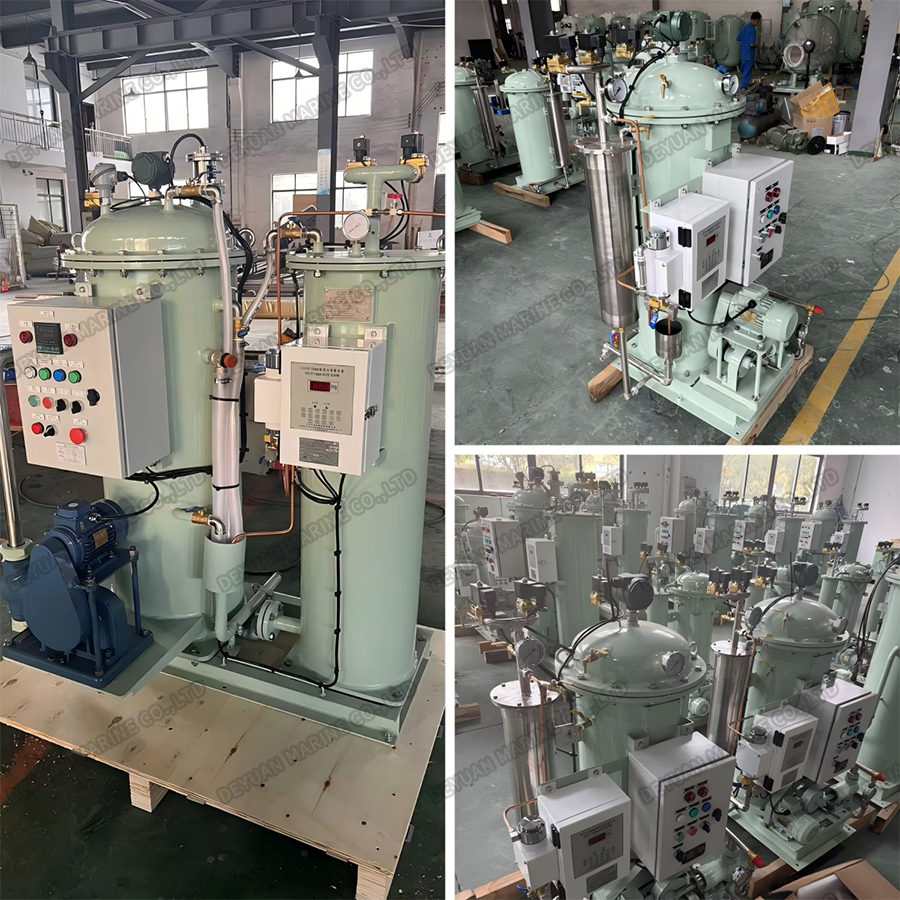
Deyuan Marine oily water separators are designed and manufactured in strict compliance with IMO Resolution MEPC.107(49) and its subsequent amendment MEPC.285(70). They are specifically developed for treating oily bilge water from vessel engine rooms, separating oil from water to meet discharge standards.
The typical model DY-2.0 has a treatment capacity of 2.0 m³/h, with effluent oil content consistently controlled below 15ppm. Deyuan Marine can provide models with various capacities to meet the requirements of different vessel types.
2. Working Principle & Core Process
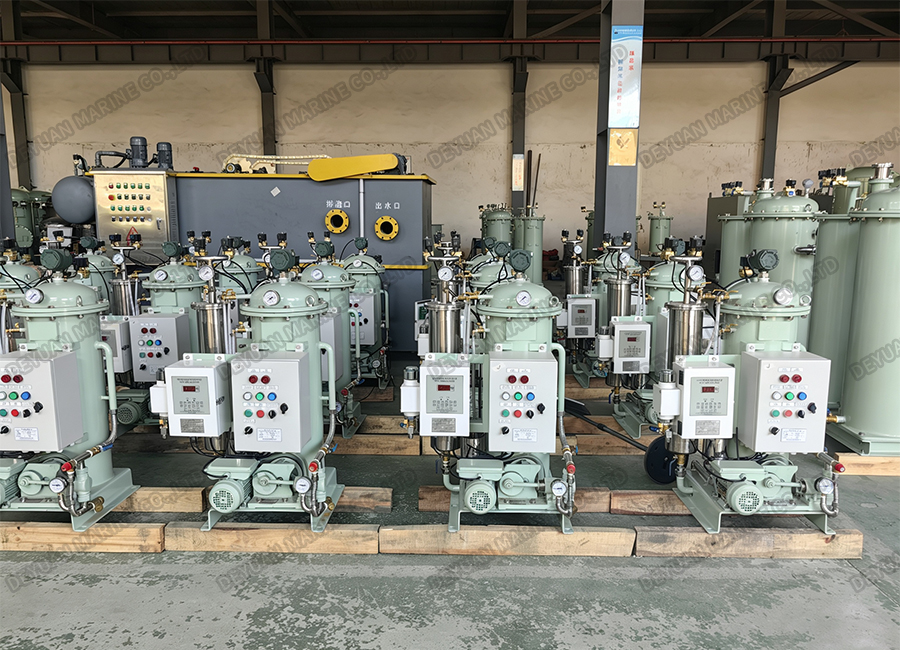
Deyuan Marine oily water separators employ multi-stage combined separation technology, comprising the following core treatment stages:
Stage 1: Gravity Coarse Separation
Oily bilge water enters the primary separation chamber via a dedicated pump unit, where gravity separation is utilised based on the density difference between oil and water. Deyuan Marine adopts a vacuum negative pressure design to avoid oil-water emulsification caused by pump agitation, which is a common issue in traditional pressure-type separators.
Stage 2: Coalescing Fine Separation
After coarse separation, the water enters the secondary separation chamber, equipped with high-performance coalescer elements. The coalescer aggregates tiny oil droplets (smaller than 20 microns) into larger droplets, making them easier to separate and float. Deyuan Marine's coalescers feature special materials and structural design with automatic back-flushing capability – they resist clogging and require no replacement over the long term.
Stage 3: Fine Filtration & Membrane Separation
Select models are equipped with a tertiary ultrafiltration membrane system as the final polishing stage, ensuring that effluent oil content remains below 15ppm under all operating conditions.
Automatic Oil Discharge & Heating System
*Automatic oil discharge control: Oil level detection electrodes automatically control the opening and closing of the oil discharge solenoid valve, directing separated oil to the waste oil tank.
*Heating temperature control: The oil collection chamber is equipped with an electric heater, maintaining temperature at 35-45°C to ensure smooth discharge of high-viscosity waste oil.
3. Core Technical Advantages
3.1 Compliance with Latest IMO Standards
Deyuan Marine oily water separators hold CCS Type Approval Certificates and IMO recognition, and are available with certification from ABS, BV, DNV, GL, LR and other major classification societies. The products meet all design, construction and performance requirements of MEPC.107(49).
3.2 15ppm Bilge Alarm & Automatic Shut-off System
Deyuan Marine provides matching 15ppm bilge alarm devices (Oil Content Meters) using infrared optical measurement technology for real-time monitoring of effluent oil content. The system features:
*Real-time monitoring: Continuous detection of oil content; discharge allowed when readings are ≤15ppm.
*Alarm upon exceedance: Audio-visual alarm triggered when oil content exceeds 15ppm.
*Automatic shut-off: When exceedance occurs, a 3-way valve automatically diverts the effluent back to the bilge tank.
*Data logging: Stores at least 18 months of operational history for PSC/FSC inspection.
3.3 Anti-Tampering Design
In accordance with MEPC.107(49), the 15ppm bilge alarm is equipped with anti-tamper seals and a freshwater flushing alarm – when clean water is used for cleaning or zero calibration, the system automatically triggers an alarm, effectively preventing illegal discharge manipulation.
3.4 Recirculation Arrangement
Deyuan Marine oily water separators are equipped with a recirculation arrangement installed near the automatic shut-off device outlet, allowing the system to be tested with the overboard discharge valve closed – convenient for self-testing and PSC inspection demonstrations.
3.5 Reliable Coalescer Design
Deyuan Marine has extensive practical experience in coalescer design. Research indicates that vertical tube coalescers tend to trap solid particles, leading to clogging and frequent replacement. Deyuan Marine's optimised coalescer design effectively avoids these issues, ensuring long-term stable operation.
4.Typical Technical Specifications
Parameter | DY Series (Standard) | HCS Series (High Capacity) |
Capacity | 0.25 – 5 m³/h | 5 – 10 m³/h |
Effluent Oil Content | ≤15ppm | <150mg/L (pre-treatment) |
Operating Mode | Vacuum negative pressure | Hydrocyclone centrifugal |
Target Vessels | Bulk carriers, tankers, container vessels, workboats | Large vessels, FPSOs, offshore platforms |
Classification Approvals | CCS, ABS, BV, DNV, etc. | CCS, etc. |
5. Applications
Deyuan Marine Oily Water Separators are widely used in:
Application Area | Description |
Vessel engine room bilge water | All types of commercial vessels, workboats, tugboats |
Offshore platform oily wastewater | Drilling platforms, production platforms |
Port/terminal oily wastewater | Shore-based treatment facilities |
Industrial oily wastewater | Factory and mining wastewater treatment |
6. Industry Recognition
Deyuan Marine has earned recognition from numerous international shipowners through quality products and professional services. The company's Oily Water Separator technology has received CCS, BV, EC Type Approval and IMO recognition.
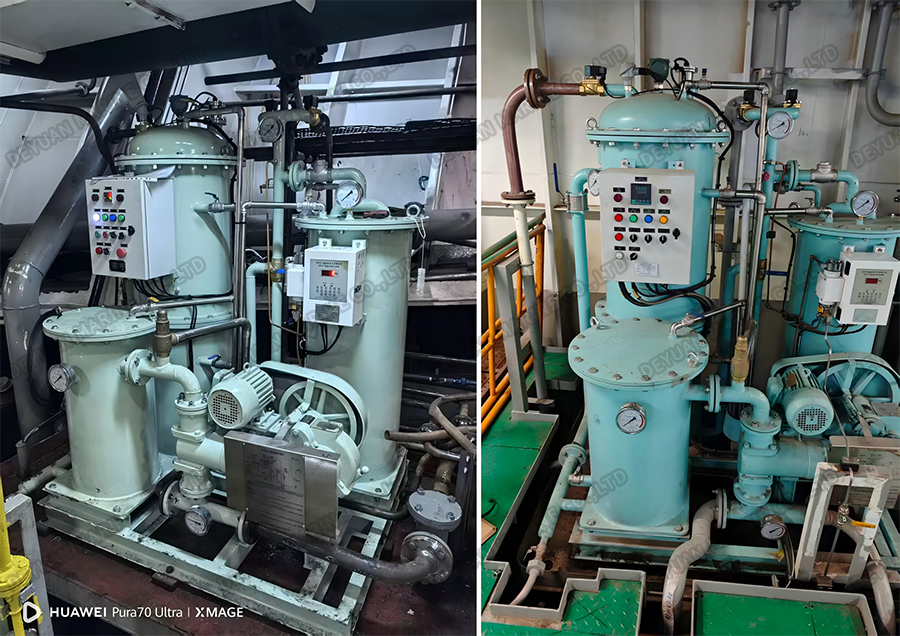
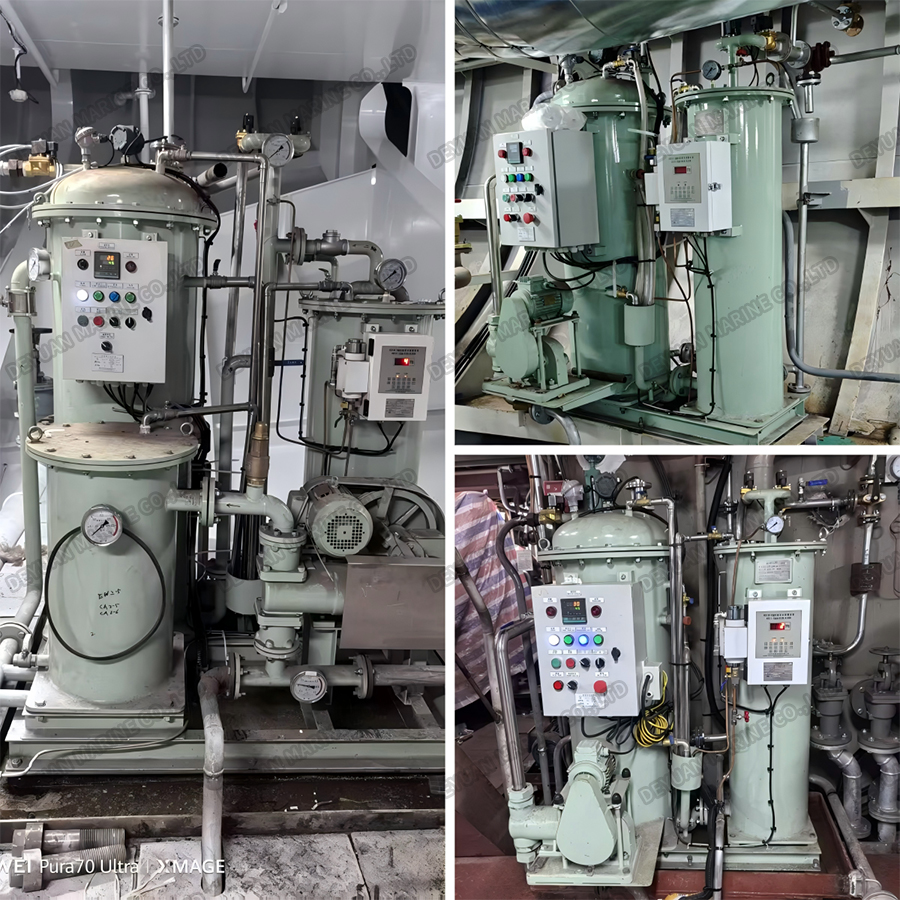
Partial cases of installation and use of oil-water separators on ships.
15ppm Bilge Separator (Oily Water Separators) - FAQ
Q1: What is a 15ppm Bilge Separator?
A1: 15ppm Bilge Separator (also known as an Oily Water Separator or OWS) is a device used onboard ships to separate oil from bilge water mixtures. It is designed to produce an effluent containing not more than 15 parts of oil per million parts of water by volume. The system typically consists of a separator unit, a special-purpose pump, an electric control box, a 15ppm bilge alarm device, suction filters, and associated pipelines, valves, and fittings.
Q2: Why is the limit set at 15ppm?
A2: The 15ppm limit is the international standard established by MARPOL Annex I, Regulation 14, to prevent oil pollution from ships. Any discharge overboard must contain no more than 15 parts of oil per million parts of water.
Q3: What vessels are required to have a 15ppm Bilge Separator?
A3: Any ship above 400 gross tonnage (GT) is required by MARPOL Annex I, Regulation 14 to have oil filtering equipment installed that can produce an effluent of 15ppm maximum.
Q4: What regulations govern 15ppm Bilge Separators?
A4: The primary regulation is IMO Resolution MEPC.107(49) – the "Revised Guidelines and Specifications for Pollution Prevention Equipment for Machinery Space Bilges of Ships". Equipment installed on or after 1 January 2005 must be approved to meet this resolution. The system must also comply with MARPOL Annex I Regulation 14.
Q5: What are the key components required by MEPC.107(49)?
A5: The system must include:
*15ppm Bilge Separator
*15ppm Bilge Alarm (Oil Content Meter / OCM)
*An automatic stopping device
Additionally, the installation must include a sampling point in a vertical section of the water effluent piping as close as practicable to the separator outlet, and recirculating facilities to enable testing with the overboard discharge closed.
Q6: What is a "truly representative sample" and why is it important?
A6: MEPC.107(49) requires that the arrangement for extracting samples from the discharge line to the bilge alarm must provide a "truly representative sample of the effluent with an adequate pressure and flow". The sampling point should be in a vertical section of pipe to ensure the sample is homogenous and to avoid oil flowing on top of a horizontal pipe. Failure to provide a representative sample is considered non-compliance.
Q7: What happens when the oil content exceeds 15ppm?
A7: The Oil Content Meter (OCM / 15ppm bilge alarm) continuously monitors the effluent. If the oil content exceeds 15ppm, the alarm is activated and the automatic stopping device (typically a three-way valve) diverts the effluent either back to the separator inlet or to the bilge holding tank. The total response time from detection to stopping discharge must not exceed 20 seconds.
Q8: How fast must the bilge alarm respond?
A8: The 15ppm bilge alarm's response time (the time between a change in the sample and the ppm display showing the correct reading) must not exceed 5 seconds. The total system response time (including activation of the automatic stopping device) must not exceed 20 seconds.
Q9: What is the required accuracy of a 15ppm bilge alarm?
A9: According to IMO requirements, a 15ppm bilge alarm must be accurate to within ±5 ppm.
Q10: Can machinery space bilges be pumped while at anchor?
A10: Generally, no – MARPOL requires that the vessel be "en-route" for discharge of machinery space bilges. Special areas and the Antarctic area have additional restrictions.