
 English
 Views: 200 Author: DEYUAN 041 Publish Time: 2026-08-17 Origin: Site

Against the backdrop of modern ships increasingly relying on integrated networks and digital switching systems, a seemingly "primitive" communication tool—the batteryless telephone—is still mandatorily required by international maritime regulations to be equipped on every oceangoing vessel.
It operates independently of the ship's main power supply or batteries, relying solely on the conversion of acoustic energy generated by both speaking parties into electrical energy to enable point-to-point instant voice communication. It is precisely this completely passive operating characteristic that makes the batteryless telephone the most reliable and resilient communication "baseline" for ships under extreme emergency conditions. As an important component of the ship's internal communication system, the batteryless telephone is not only a liaison tool for daily operations but also a safety device explicitly mandated by the SOLAS Convention, carrying the last hope for life-saving communication in critical moments.
The fundamental value of the marine batteryless telephone lies in its "independence." When a ship encounters emergencies such as fire, collision, or engine room flooding, resulting in main power system failure and programmed switching system paralysis, the batteryless telephone can still function properly through its self-generating principle, establishing interference-free voice channels between key stations including the bridge, engine room, steering gear room, and fire control station. This characteristic enables the captain to issue timely commands and transmit damage information during critical phases such as emergency ship maneuvering and damage control, effectively coordinating emergency response actions.
In addition, the batteryless telephone is equipped with noise-canceling headphones that fit tightly against the head, ensuring clear communication even in high-noise engine room environments, greatly enhancing communication reliability. Its direct mode of operation—requiring no dialing and featuring off-hook instant talk—further avoids delays caused by complex procedures in time-critical emergencies.
Technical Data:
| Temperature | -10℃~+55℃ |
| Environment Noise | ≤ 85dB |
| With Noise-proof Headset | ≤ 110dB |
| Sound of Receiver | ≥ 85dB |
| Extension Gain | 20±3dB |
| Power for Extension | DC24V+30% -25% 0.3A |
| Bell Contact | AC125V/1A DC30V/2A |
| With Features against vibration, incline, dampness, mildew and salt fog | |
With its simple and reliable physical principles, the batteryless telephone forms a solid foundation for shipboard emergency communication. Choosing a duly certified batteryless telephone is not only strict compliance with international conventions but also a profound appreciation for every second of communication in times of emergency.
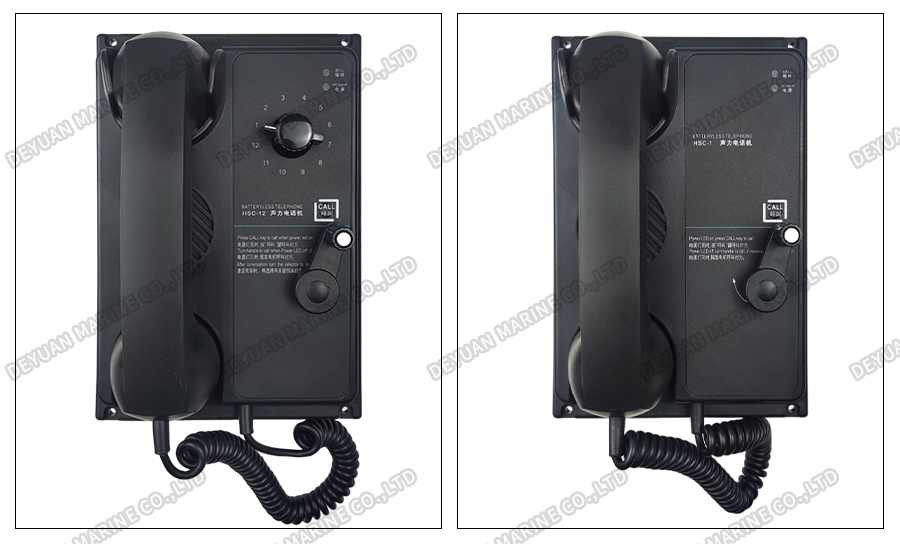
Marine Batteryless Telephone-FAQ
Q1: What is a marine batteryless telephone?
A: A marine batteryless telephone is an onboard communication device that operates without relying on external power sources or built-in batteries, enabling communication even when the vessel is completely blacked out. It typically includes sound-powered telephones and magneto telephones. According to standards such as ISO 21792:2019 and GB/T 42724-2023, batteryless telephones are classified alongside automatic telephones and common battery telephones as onboard telephone equipment.
Q2: What are the main types of marine batteryless telephones?
A: There are two main types: (1) Direct-line (straight-through) — direct communication between two users; (2) Selective (multi-way) — selective calling between multiple users via a selector switch. Selective systems typically support configurations of up to 12 or 20 stations. Based on mounting methods, they can also be classified as desktop, wall-mounted, flush-mounted, and portable types.
Q3: How does a marine batteryless telephone work?
A: The core principle is electroacoustic conversion. When speaking, sound vibrations cause the transmitter diaphragm to vibrate, changing the air gap in the magnetic circuit and inducing a current in the transmitter coil. This current is transmitted through the telephone line to the receiver coil of the called party, where it recreates the sound through diaphragm vibration. The entire conversation requires no external power. Ring signals are generated either by a hand-cranked generator (magneto type) or a call button (sound-powered amplified type).
Q4: What is the difference between a batteryless telephone and a regular marine automatic telephone?
A: The main differences lie in power dependency and purpose. Automatic telephones rely on the vessel's main power supply or batteries — they offer loud volume and rich features for daily use, but become inoperable during power outages. Batteryless telephones operate completely independent of external power and are specifically designed for emergency communication and reliable联络 between critical positions. According to regulatory requirements, critical areas such as the engine room, steering gear room, bridge console, and control room should be equipped with sound-powered telephones or battery-powered command telephones as the primary means of communication.
Q5: What are the installation requirements for marine batteryless telephones?
A: Installation must be performed by qualified professionals, ensuring secure and correct connections, proper grounding, and compliance with marine electrical installation specifications. Cables should be of approved ship cable type. A full 12-station system typically requires 8 pairs of wires, with the screen connected to the designated terminal to avoid noise issues. Compass safety distance must also be observed during installation to avoid interference with navigation equipment. Relevant installation requirements can be found in GB/T 42724-2023 and ISO 21792:2019.
Q6: What routine maintenance does a marine batteryless telephone require?
A: Routine maintenance should include: (1) Regularly inspect terminals and junction boxes for oxidation or loose connections; (2) Check the mechanical components of the hand-cranked generator for proper operation; (3) Test the ringing function; (4) Keep equipment dry and check watertight integrity to prevent moisture-related failures; (5) Conduct periodic functional tests, including shop tests and onsite tests. Specific maintenance requirements can be found in GB/T 42724-2023 and ISO 21792:2019.
Q7: What classification society certifications are required for marine batteryless telephones?
A: Marine batteryless telephones typically require type approval from major classification societies, including: CCS (China Classification Society), ABS (American Bureau of Shipping), LR (Lloyd's Register), BV (Bureau Veritas), DNV (Det Norske Veritas), NK (Nippon Kaiji Kyokai), KR (Korean Register), IRS (Indian Register of Shipping), RMRS (Russian Maritime Register of Shipping), among others. Specific certification requirements depend on the vessel's flag state and trading area — confirm required certifications before procurement.