
 English


For a custom hydraulic cylinder, procurement and QC should agree on three separate gates before shipment: routine acceptance and function testing for the cylinder, aligned with the scope of ISO 10100:2020 as listed by SIS; safe test boundaries within the wider hydraulic-system context addressed by ISO 4413:2010; and project witness or inspection requirements where competence, impartiality, and consistent inspection activity matter.
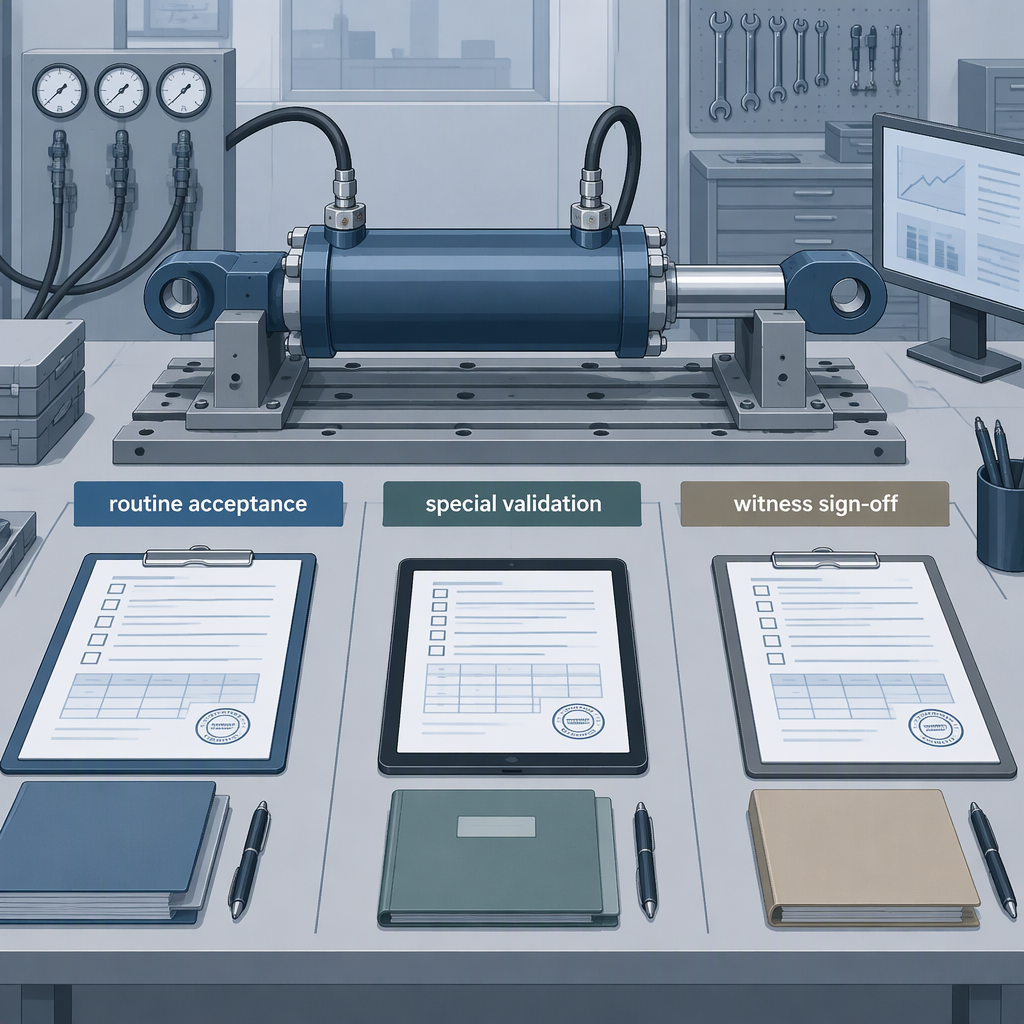
Start by defining the acceptance-test scope
A pre-shipment hydraulic cylinder acceptance test should first state that the required test evidence concerns acceptance and function testing for hydraulic fluid power cylinders, because SIS lists SS-ISO 10100:2020 as valid and identifies it as Hydraulic fluid power — Cylinders — Acceptance tests.
Use the named standard and edition as the contract reference point: the SIS page for SS-ISO 10100:2020 states that the document specifies acceptance and function tests for hydraulic fluid power cylinders.
First confirm which shipment-release decision the test supports. Tie routine acceptance to the purchase specification, drawing revision, configuration, packaging requirements, and shipment report.
Separate routine functional checks from project-specific criteria
Routine functional acceptance should be written as a documented release check for the ordered cylinder, while exact pressures, holding times, leakage limits, stroke requirements, and cycle counts should come from the controlled standard text and the project specification rather than from a generic checklist.
| Verification area | What procurement should specify | What QC should expect before shipment |
|---|---|---|
| Cylinder identity | Purchase order, drawing revision, model or tag number, and quantity | A report that can be matched to the physical cylinder and shipping documents |
| Functional movement | Required stroke, mounting orientation for test if relevant, and acceptable function result | A recorded pass/fail result tied to the agreed acceptance method |
| Pressure or load-related checks | Project-specific values from the specification and controlled standard text | Recorded values, equipment identification, and reviewer approval |
| Leakage or sealing observation | Acceptance limit and inspection point, if applicable to the project | A clear statement of the result and any corrective action before release |
| Final release | Who signs the report and whether buyer review is required before shipment | A shipment dossier that matches the contract release gate |
This separation keeps the test record traceable from the order requirement to the observed result for procurement and incoming QC.
Confirm test boundaries, safety controls, and system context
Cylinder acceptance testing should be planned within the broader hydraulic-system safety context, because SIS lists SS-EN ISO 4413:2010 as valid and describes its scope as general rules and safety requirements for hydraulic systems and components.
- Confirm which hydraulic system or test-rig conditions are relevant to the component being tested, since ISO 4413:2010 is scoped to hydraulic systems and their components in machinery.
- Define who is allowed to operate the test equipment, who may review results, and who may approve release.
- Record the test medium, cleanliness expectation, connections, ports, fixtures, gauges, and calibration references required by the project.
- Require that any hands-on inspection or manual access to a connected test rig occurs only after the rig is depressurized and the relevant electrical, hydraulic, or battery power source is switched off and disconnected under the site procedure.
- State whether the test is performed on a standalone cylinder, a cylinder with accessories, or a project assembly, because the release meaning changes with the configuration.
Treat low-temperature validation as a separate requirement
If the cylinder will be stored, started, or operated in cold conditions, treat low-temperature validation as a special project requirement in addition to routine functional acceptance.
Routine functional acceptance
Use this gate to confirm that the ordered cylinder has passed the agreed pre-shipment functional release checks. Keep it tied to the normal purchase specification and shipment dossier.
Low-temperature validation
Use this gate when the application creates a cold-service risk. Define the temperature condition, conditioning method, acceptance criteria, seal or fluid assumptions, and whether the buyer must witness the result.
For procurement, the decision is whether cold behavior is part of the delivered-cylinder acceptance package or a separate qualification activity. If it is separate, write it that way: name the cold condition, the sample or production unit to be tested, the required record, and whether shipment is blocked until the special validation is accepted.
Decide whether the project needs witness inspection
Require witness inspection when the buyer needs independent or project-controlled observation of the acceptance test, and define the role carefully because ISO/IEC 17020:2026 concerns inspection-body competence, impartiality, and consistent performance of inspection activities.
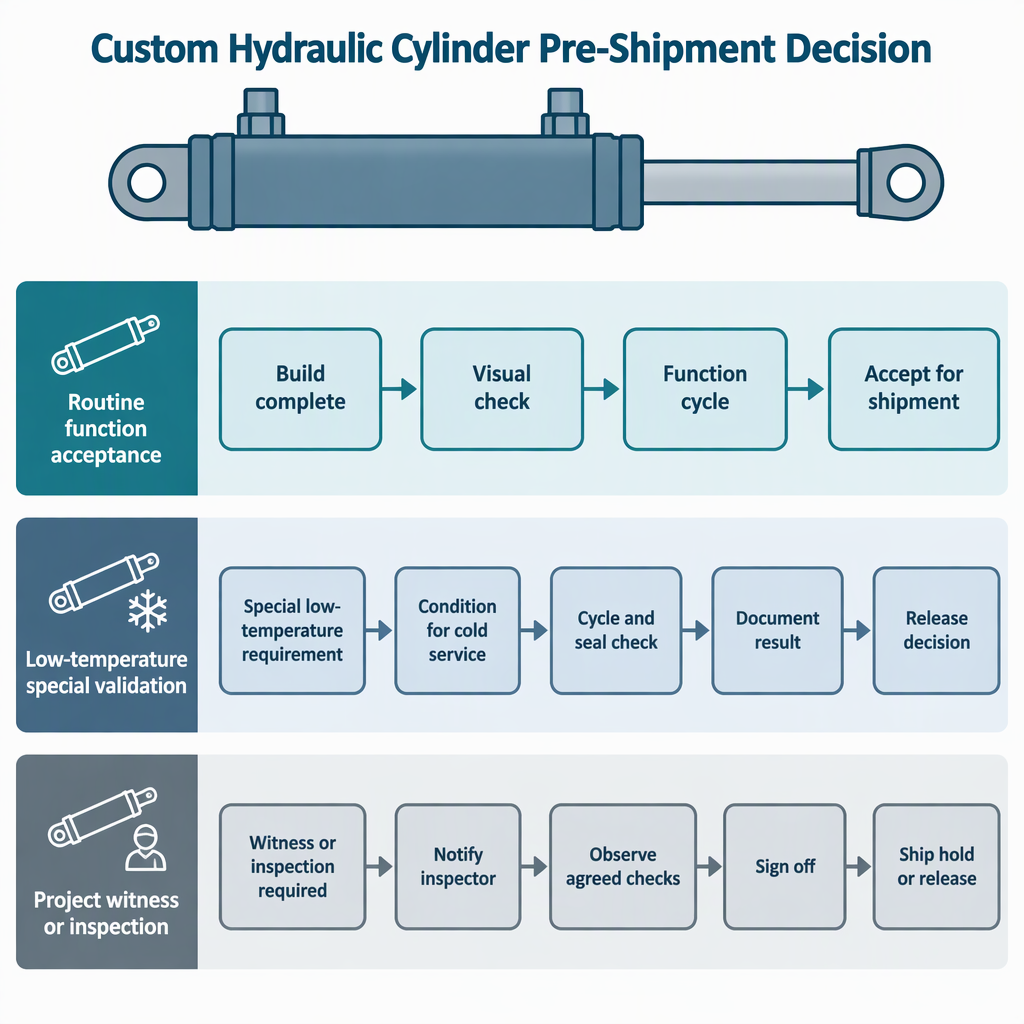
- Decide whether normal supplier test records are sufficient for shipment release.
- Identify any contract, class, end-customer, or project requirement for buyer witness, third-party witness, or document review.
- State the hold point: before test start, during functional test, during special validation, or before final packing.
- Define the witness package: purchase order, drawing, inspection and test plan, calibrated equipment references, test report, nonconformity record if any, and release signature.
- Confirm how missed witness attendance is handled so the shipment is not delayed by unclear approval rules.
For third-party or formal inspection planning, the SIS page for SS-EN ISO/IEC 17020:2026 identifies the standard as covering requirements for bodies performing inspection, including competence, impartiality, and consistent inspection activity.
Build the pre-shipment documentation checklist
A good shipment-release file should connect the cylinder, the acceptance test, any special validation, and any witness requirement into one traceable package.
- Exact acceptance-test standard reference and edition, including ISO 10100:2020 where it is the agreed cylinder acceptance and function test reference.
- Purchase order, drawing revision, item tag, quantity, and configuration description.
- Inspection and test plan showing routine acceptance, special validation, witness points, review points, and shipment-release responsibility.
- Test report with the actual cylinder identity, test date, equipment references, recorded results, acceptance decision, and authorized signature.
- Safety and system-boundary notes for the hydraulic component or test setup where relevant to the project context.
- Low-temperature validation record, if the order requires cold-condition confirmation.
- Witness or inspection record when the project requires inspection activity by a buyer representative or inspection body.
- Packing, preservation, port protection, marking, and document-copy requirements for shipment handover.
Procurement should make the dossier requirement part of the order, not a request after the cylinder is ready to ship. QC should reject release records that cannot be matched to the ordered unit, the agreed acceptance criteria, or the person authorized to approve shipment.
Use standards scopes carefully before approving shipment
Use the published scope and status of a standard to identify the right reference, then use the controlled standard text, project drawings, and purchase specification to set detailed acceptance values.
- ISO 10100:2020 is the relevant acceptance and function test reference for hydraulic fluid power cylinders when that edition is specified.
- ISO 4413:2010 provides broader hydraulic-system and component safety context, not a replacement for cylinder-specific acceptance criteria.
- ISO/IEC 17020:2026 is useful when planning formal inspection roles, but it does not by itself prove any specific inspector or supplier status.
- Low-temperature validation should be written as a separate project requirement when cold storage, start-up, or operation affects the buying decision.
Conclusion
Before shipment, release the custom hydraulic cylinder only when routine functional acceptance, special low-temperature requirements, witness or inspection obligations, and the final documentation package all match the purchase specification.
For procurement and QC, the strongest position is a written inspection and test plan before production release. It should distinguish normal acceptance from special validation, identify who may witness or approve each hold point, and make the shipment dossier traceable to the exact cylinder being shipped.
FAQs
These questions help buyers turn the acceptance-test requirement into a practical pre-shipment release checklist.
What is a hydraulic cylinder acceptance test?
It is the agreed pre-shipment acceptance and function test package for a hydraulic fluid power cylinder, with ISO 10100:2020 identified by SIS as a standard that specifies acceptance and function tests for such cylinders.
Is a routine acceptance test enough for every custom cylinder?
No. Routine acceptance may be enough for a standard shipment-release decision, but special service risks such as cold conditions, project witness points, accessory checks, or end-customer documentation rules should be added to the order separately.
Should the buyer state exact test values in the purchase order?
Yes, when those values are part of the release decision. Exact pressure, timing, leakage, cycle, temperature, and retest values should come from the controlled standard text, engineering specification, and agreed drawing package.
When should low-temperature validation be required?
Require it when the cylinder will face cold storage, cold start-up, or cold operation that affects sealing, movement, fluid behavior, or buyer acceptance. Put the condition, method, criteria, report, and shipment hold rule in the contract.
When should witness inspection be required?
Require witness inspection when the buyer, end customer, or project needs controlled observation or inspection activity; ISO/IEC 17020:2026 is relevant to inspection-body competence, impartiality, and consistent inspection activity.
Why include hydraulic-system safety context in a cylinder acceptance plan?
SIS describes ISO 4413:2010 as addressing general rules and safety requirements for hydraulic systems and components, so test planning should define safe system boundaries rather than treating the cylinder test as an isolated paperwork exercise.
Which documents should be checked before shipment release?
Check the purchase order, drawing revision, inspection and test plan, acceptance report, special validation report if required, witness or inspection record if required, nonconformity closure, packing and preservation record, and the final shipment document set.
What should QC do if the test record does not match the purchase order?
Hold shipment release until the supplier reconciles the item identity, drawing revision, acceptance criteria, and approval authority. A record that cannot be traced to the ordered cylinder is not a reliable release document.