 English
 Views: 0 Author: Site Editor Publish Time: 2026-04-06 Origin: Site

Marine cables give power, control, and help check systems on ships and offshore platforms. It is important to know the different types and specifications. Your choices affect safety, rules, and how well things work. Deyuan Marine sells strong marine cables. These cables work well in tough places.
The world marine cables market was $5,133.82 million in 2021. By 2025, it will be $6,612.43 million. The market should reach $10,969.9 million by 2033. It will grow about 6.532% each year.
Date | Location | Committee Link |
|---|---|---|
8-12 June | Marseille (France) | |
15-16 June | Paris (France) | |
16-18 June | Saint-Denis (France) | |
16-19 June | Hamburg (Germany) | |
17-19 June | Paris (France) |
New ideas, like modular design and better connector technology, make marine cables safer. They are also easier to put in. You can use this guide to make good choices for your ships or marine projects.
Marine cables give power and connect systems on ships and platforms. They help keep everything safe and working right.
Marine cables are not like regular cables. They use special materials that fight saltwater, heat, and shaking. This helps them last longer at sea.
You must pick the right cable for its job. It depends on if you need power, control, or communication. The place where you put the cable also matters.
You should check for certifications like IEC 60092, ABS, or DNV. These show the cable is safe and follows marine rules.
Knowing cable markings and color codes is important. It helps you avoid wiring mistakes and keeps your ship safe.
Some cables are fire-resistant or halogen-free. These special cables protect people and equipment in emergencies.
New trends are smart cables with sensors and green materials. These make things safer and help the environment.
Experts like Deyuan Marine can help you choose the best cables. They help you follow the rules and give support for your projects.
Marine cables connect and power things on ships and platforms. They help run engines, lights, and control panels. These cables carry electricity, signals, and data. You can find them on oil rigs, wind farms, and underwater pipelines. There are different marine wire types like power cables, control cables, and communication cables. Each type does a special job. Marine wire helps you use equipment safely and keeps your ship working well.
Marine cables are important in many industries.
People use them for power and communication on drilling platforms.
They send energy from wind farms in the ocean.
Submarine cables link countries and move data worldwide.
Life at sea is hard on wires. Saltwater, humidity, and temperature changes can hurt regular wires. Marine electrical cables are made to handle these problems. You need marine-rated wires because they do not rust easily and last longer. These cables keep your ship safe from electrical problems. You depend on marine wire to keep systems safe and working. Using the right marine wire helps you avoid expensive repairs and delays.
Marine cables are not the same as regular industrial cables. Marine electrical cables have special features. They have strong insulation and resist water. Marine wire uses tinned copper conductors to stop rust. Regular cables do not have these protections. Marine cables work better in tough places. You pick marine-rated wires for safety and trust. The marine wire you choose depends on what you need and the sea conditions.
It is important to know about marine electrical cables. These cables are used on ships and offshore platforms. Each cable does a different job. The table below shows what each cable does.
Type of Marine Cable | Function |
|---|---|
Ship Power Cable | Power transmission for ships and offshore buildings in rivers and seas. |
Ship Control Cable | Control signal transmission for ships and offshore buildings. |
Ship Communication Cable | Signal transmission for communication and information processing systems. |
Shipboard power cables move electricity all over your ship. You use them for engines, lights, pumps, and other things. Deyuan Marine makes strong cables for hard marine places. You can pick the type that fits your needs.
Low voltage power cables are used a lot on ships. They are for things that need less than 1,000 volts. These cables power lights, small motors, and control panels. You find them in cabins, engine rooms, and navigation areas. The insulation keeps out water and salt. This gives your ship safe and steady power.
Medium voltage power cables are for bigger jobs. They work for things that need between 1,000 and 15,000 volts. These cables power big engines, pumps, and heavy machines. Medium voltage cables are tough and resist heat, oil, and water. You use them for main power on large ships and offshore platforms.
Tip: Pick the right power cable for your ship’s size and energy needs. This helps stop overloads and keeps your ship safe.
Shipboard control cables help you manage equipment. You use them to send signals to machines, alarms, and sensors. These cables make sure your ship’s systems work together. You can use them for control, power, and communication circuits.
Shipboard control cables are easy to install. You do not need lots of separate cables.
Shielded cables block interference. You get good signals.
These cables last a long time because they resist water and damage.
Tinned copper conductors help stop rust.
You use shipboard control cables for steering, engine control, and safety. These cables help lower air pollution and noise. You also use less time on extra engines and make the air cleaner.
Shipboard instrumentation cables help you watch and control ship systems. You use them to connect sensors and instruments. These cables send data and control signals around your ship. They are important for navigation, safety, and engine control.
Shipboard instrumentation cables work well in tough marine places. You get good signals even with shaking and wetness. These cables help your ship’s network. You can check and control important information to keep your ship safe.
Note: Shipboard instrumentation cables help you keep your ship safe. You can watch systems and act fast if something changes.
You use marine and shipboard cables for many things:
Ships and vessels: Power navigation, lights, and communication tools.
Offshore platforms: Send power and data for oil rigs and wind farms.
Underwater places: Connect underwater robots, research tools, and communication lines.
You need to choose the right marine electrical cables for your ship. Each cable has a special use and helps your ship work well.
Communication and data cables help send signals on your ship. These cables connect radios, computers, alarms, and navigation systems. You need them to keep your crew talking and equipment working together. There are two main types you will see on ships: data transmission cables and coaxial or fiber optic cables.
Data transmission cables move information between devices. You use them for computers, sensors, and control panels. These cables help you share data fast and safely. They can handle water, oil, and shaking. You can trust them even when the sea is rough.
You will see these cables used in many ways:
Connecting bridge equipment for navigation.
Linking engine room monitors to control stations.
Sending signals to alarms and safety systems.
Data transmission cables are part of marine electrical cables that keep your ship running well.
Coaxial cables carry signals for radios, TVs, and cameras. Fiber optic cables send lots of data using light. You use fiber optic cables for fast internet and advanced communication. Both types resist saltwater and heat. They last a long time on ships.
You can compare marine communication cables with submarine cables in this table:
Feature | Marine Cables | Submarine Cables |
|---|---|---|
Purpose | Wiring on ships and offshore platforms | Long-distance undersea data and power transmission |
Environment | Shipboard, exposed to moisture, saltwater | Deep seabed, exposed to high pressure and currents |
Construction | Flame-retardant, oil-resistant, fire-resistant | Steel-armored, pressure-resistant, waterproof |
Voltage/Data Levels | Low to medium voltage (up to 33 kV) | Medium to high voltage (220 kV – 525 kV) and multi-terabit fiber optic cores |
Mechanical Strength | Designed for vibration, heat, and mechanical stress on vessels | Designed to withstand anchor drops, fishing trawlers, abrasion, and deep-sea pressure |
Installation Method | Installed manually on vessels using clamps and trays | Installed using specialized vessels, remotely operated vehicles (ROVs), and seabed trenching tools |
Certifications | IEC 60092 marine standards | ITU Submarine Cable Standards |
You need to pick the right type for your ship. Shipboard cables from Deyuan Marine meet strict safety and performance rules.
Special purpose marine cables give extra protection and features. You use them where safety, flexibility, or special materials are important. These cables include fire-resistant, halogen-free, flexible, and marine grade options.
Fire-resistant cables keep working during a fire. You need them for alarms, emergency lights, and control systems. These cables use materials that do not burn easily. They help keep important systems running when you need them most.
They keep working during a fire.
They use materials that can handle high heat and do not burn.
They are important for safety and reliability at sea.
Halogen-free cables protect you and your crew from toxic smoke. When these cables burn, they do not make harmful gases. You use them in cabins, control rooms, and other closed spaces. They are better for the environment and safer for people.
They make little smoke and no halogen when burned.
They make closed spaces safer by lowering toxic gas.
They are better for the environment because they have no harmful halogen.
Flexible cables bend easily. You use them in tight spaces or where things move a lot. Tinned cables have a special coating that stops rust. These cables last longer in wet and salty places. Marine grade flexible cables are great for pumps, motors, and moving parts.
Type P cables work well on offshore platforms and ships. They resist oil, water, and chemicals. You use them for power, control, and communication. 316 marine grade cables use stainless steel for extra strength and to stop rust. These cables are best for tough marine places.
You can find many types of marine and shipboard cables for different jobs. Deyuan Marine has a full range of shipboard cables to fit your needs.
It is important to know what makes marine cables strong. The conductor inside the cable moves electricity. The material you pick changes how well the cable works and lasts.
Copper is a popular choice for marine wire. It lets electricity flow easily and is strong. You get steady power and signals. Tinned copper wire has a coating that protects it. This coating stops saltwater from causing rust. Tinned copper wire lasts a long time in marine-grade wire.
Copper lets electricity flow well.
Tinned copper wire does not rust and keeps working.
Both materials can carry lots of electricity.
Most marine electrical cables use these conductors.
Aluminum is lighter than copper. You use it when you need to save weight, like on overhead power lines. It costs less and still carries electricity well. Aluminum is not used much in marine-grade cables, but it helps make cables lighter in some cases.
Aluminum is light and costs less.
It works for power when weight matters.
You must check the size to make sure it carries enough electricity.
Stainless steel, especially 316 marine-grade, is good for tough places. You use it for cables that need to be strong and not rust. It works well where there is saltwater and chemicals.
316 marine-grade wire does not rust.
It is strong and lasts in hard marine places.
You find it in special marine electrical cables.
Insulation and sheathing cover the conductor. They keep water, oil, and chemicals away. You need to pick the right material for your cable’s job.
Cross-linked polyethylene (XLPE) keeps water out. It protects cables from getting wet. You get steady performance and cables that carry lots of electricity.
XLPE keeps water and moisture away.
It works with high voltage and heat.
Many marine electrical cables use XLPE.
Ethylene propylene rubber (EPR) bends easily and lasts long. You use it in cables that move or bend. EPR stands up to oil and tough marine places.
EPR bends and is strong.
It protects against oil and chemicals.
It works well in marine wire for moving parts.
Thermoplastic elastomer (TPE) does not have halogen and bends easily. It stays strong in cold and tough places. You use TPE for cables that need to twist and bend.
TPE does not have halogen and bends easily.
It stays strong in cold places.
It protects cables in tough marine places.
Halogen-free compounds keep people safe. They do not make toxic gases if burned. You use them in closed spaces like cabins and control rooms.
Halogen-free compounds make less smoke and toxic gas.
They make marine-grade wire safer for people and nature.
Many marine electrical cables use them.
You must check voltage and temperature ratings before picking a cable. These ratings show how much power and heat the cable can handle.
Parameter | Rating |
|---|---|
Operating Temperature | −40°C to +90°C |
Voltage Ratings | 0.6/1kV, 3.3kV, 6kV |
You need to match the cable’s size and how much electricity it carries to your system. This stops cables from getting too hot and keeps your ship safe.
Tip: Always check marine electrical cable ratings for voltage and temperature. This helps your cables work safely and last longer.
You need cables that keep working if there is a fire. Marine electrical cable specifications say cables must resist flames and heat. These features protect your ship and crew. Marine wire must pass tough tests to show it can handle fire. You see these cables on offshore vessels, oil platforms, schools, and hospitals.
Here is a table with important standards for flame retardance and fire resistance:
Standard | Description |
|---|---|
IEC 60331 | Tests circuit integrity during fire exposure. Cables must operate under flames for 90 minutes. |
GB/T 19216.21-2003 | Requires longer flame exposure (over 120 minutes) and includes mechanical shock tests. |
EN 50200 | Focuses on water spray resistance with different testing methods. |
These standards help you pick cables that keep systems running in emergencies. You protect lives and equipment by following these rules.
Marine electrical cable specifications also cover environmental resistance. You need cables that stand up to water, salt, oil, chemicals, sunlight, and abrasion. These features keep your cables working in tough marine places.
Marine wire uses special materials to resist water and salt. Tinned copper conductors stop rust and corrosion. Stainless steel hardware, often 316 marine grade, prevents rust. Waterproof seals and overmolding keep salt spray out. Marine-grade polymer jackets, like XLPE and polyurethane, block water and salt but stay flexible.
You need cables that resist oil and chemicals. Marine cables use sheathing that stands up to oil, grease, and harsh chemicals. This sheathing protects the cable from breaking down and keeps moisture out. You get reliable performance in wet and chemically harsh places.
Sunlight can break down cables. Marine electrical cable specifications require UV stabilization. UV-stabilized Nylon 6/6 and high-performance polymers, like PEEK, stop polymer breakdown from sunlight. Marine-grade jackets resist abrasion from movement and contact. High tensile strength materials help cables handle vibration and wave impact. Locking mechanisms, like self-locking designs, prevent loosening when there is vibration.
Marine cables must handle movement and impacts. You need cables that bend, resist vibration, and survive harsh conditions. These specifications help your cables last longer and work safely.
Flexibility is important for cables on ships. Low bending stiffness lets cables adapt to dynamic marine conditions. Cables must withstand loads from waves and currents. Fatigue resistance stops damage from repeated movement. Vibration resistance keeps cable integrity, even with vortex-induced vibrations.
Impact resistance is key for marine wire. Cables must endure harsh conditions without failing. You see cables like Super-Trex® Ultra-Gard™ Portable Cord and Super-Trex® Type W/Type TC Portable Power and Automation Cable. These cables offer high flexibility and impact resistance. Marine electrical cable specifications require cables to survive impacts and stay reliable.
You must check specifications like cross sectional area and current carrying capacity. These details help you pick cables that fit your ship’s needs and keep systems safe.
When picking marine cables, you need to check standards. Standards show the cables are safe and reliable. Marine electrical cable specifications need strict tests. Many groups make rules for cables on ships and platforms.
IEC 60092 is a global standard. It tells you how to build and test cables. You find rules for water, fire, and vibration. IEC 60092 makes sure cables work well in tough places. If you see this mark, the cable meets safety rules.
IEEE 1580 gives guidelines for marine cable systems. It covers how to install cables and how they work. You use this standard to check if cables fit your ship. IEEE 1580 helps you pick cables that last and keep systems safe.
ABS means American Bureau of Shipping. This group checks if cables are good for marine use. DNV stands for Det Norske Veritas. It sets rules for safety and performance. Lloyd’s Register gives certificates to cables with high safety. These groups make sure cables protect your ship and crew.
You can see the main standards in the table below:
Standard | Description |
|---|---|
IEC 60092 | Defines construction, testing, and performance criteria for electrical installations on ships. |
IEEE 1580 | Provides guidelines for marine cable systems. |
ABS | American Bureau of Shipping standards for marine applications. |
DNV | Det Norske Veritas standards ensuring safety and performance. |
Lloyd’s Register | Certification for marine and offshore industries ensuring compliance with safety standards. |
Tip: Always check for certification marks when buying marine cables. These marks show the cables meet important rules and keep your ship safe.
Deyuan Marine follows these standards closely. You get cables that pass strict tests and meet global rules. You can trust Deyuan Marine to supply cables that fit your project and protect your crew. Using certified cables helps you avoid problems and keeps systems running smoothly.
You must look for cables with the right certifications. This helps you meet legal rules and keeps your ship safe. Marine electrical cable specifications include these certifications to make sure you get the best quality. If you have questions, you can ask Deyuan Marine’s experts for help.
Knowing marine cable markings helps you pick the right cable. You see important details printed or labeled on each cable. These markings tell you what the cable does and how to use it. They also show safety features. If you read these codes, you avoid mistakes. You keep your ship safe.
Marine cables have many markings. These markings show voltage rating, temperature rating, and certification. For example, “600V 105°C DRY 75°C WET UL” is a marking. This means the cable handles 600 volts. It works up to 105°C in dry places. It works up to 75°C in wet places. “UL” means the cable meets Underwriters Laboratories standards.
Color codes help you know the cable’s job. Here is a table that shows what each color means:
Color Code | Cable Function / Specification Description |
|---|---|
RED | Positive conductor in DC supply (Positive Mains "+") |
BLACK or YELLOW | Negative conductor in DC supply (Negative Mains "-") |
YELLOW with Red Stripe | Starting switch to solenoid or generator to regulator field terminal |
BROWN | Generator armature to regulator, fuse/switch to pumps or lights, generator terminal to alternator or regulator |
BROWN with Yellow Stripe | Switch or fuse to blower |
DARK BLUE | Fuses and switches to lights |
LIGHT BLUE | Oil pressure sender to gauge |
TAN | Water temperature sender to gauge |
ORANGE | Distribution panels to accessory switches, ammeter to alternator/generator output, accessory fuses/switches |
PURPLE | Ignition switch to coil and electrical instruments, distribution panel to electrical instruments |
PINK | Boat fuel gauge senders to gauge |
GRAY | Tachometer sender to gauge, fuses/switches to lights, or bonding wire (if insulated) |
GREEN or GREEN with Yellow Stripe | Bonding wires (if insulated) |
Tip: Always look for marks like UL, ABYC, or USCG. These marks show the cable is safe for marine use.
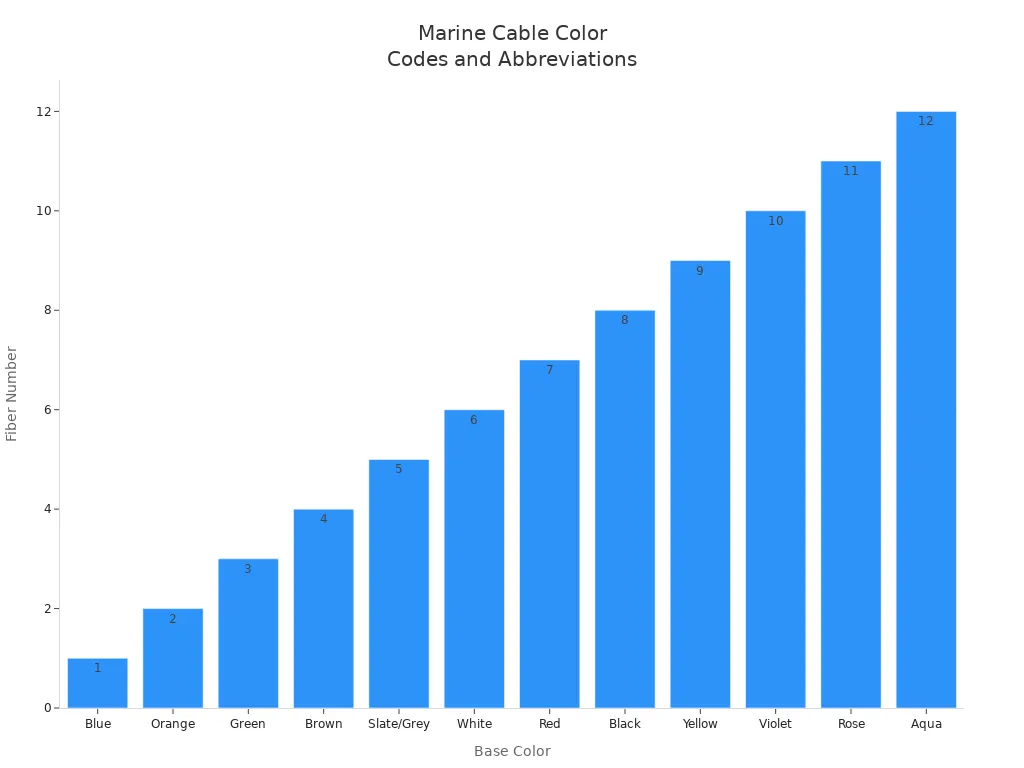
Marine cables often have abbreviations. These short codes help you know the cable’s color and type fast. “BL” means blue. “RD” means red. “BK” means black. You can use the table below to match abbreviations with colors:
Fiber # | Base color | Abbreviation |
|---|---|---|
1 | Blue | BL |
2 | Orange | OR |
3 | Green | GR |
4 | Brown | BR |
5 | Slate/Grey | SL/GY |
6 | White | WH |
7 | Red | RD |
8 | Black | BK |
9 | Yellow | YL |
10 | Violet | VI |
11 | Rose | RO |
12 | Aqua | AQ |
You might see codes like “XLPE” or “LSZH.” “XLPE” means cross-linked polyethylene insulation. “LSZH” means low smoke zero halogen. These codes tell you about the cable’s materials and safety features.
Color coding helps you spot the right cable fast. You look at the cable’s color and know its job. Red cables carry positive power. Black cables carry negative power. Green or green with yellow stripe means bonding wire. Bonding wires help stop electrical shock.
Charts help you remember color codes and abbreviations. Here is a chart that shows common marine cable colors and their abbreviations:
Note: Always check the color and marking before you connect or change a cable. This step helps you avoid wiring mistakes. It keeps your vessel safe.
If you know cable markings, codes, and colors, you work faster and safer. You make sure every system on your ship gets the right connection.
First, you need to know what your cable will do. Will it give power, send control signals, or help with communication? Each cable type has its own job. Power cables bring electricity to engines, lights, and pumps. Control cables send signals to machines and alarms. Communication cables link radios, computers, and navigation tools. Picking the right cable for each job keeps your ship safe and working.
You should check where you will put the cable. The place changes what kind of cable you need. Engine rooms need cables with strong insulation for heat. Decks need cables that can handle water and sunlight. Cables under water must fight saltwater and rust. Dry inside spaces need less protection but still need to be safe. You also have to check voltage, stress, and fire safety rules. Make sure your cable has the right certification for marine use.
Tip: Always look at where and how you will use the cable before picking one. This helps you stop problems and keeps your ship safe.
You need to match the cable’s features to your ship’s needs. Check things like voltage, current, and short-circuit levels. Think about where the cable will go, like engine rooms, decks, or under water. Make sure your cable has the right certificate from groups like ABS, DNV, or Lloyd’s Register. The table below shows what you should check:
Factor | Description |
|---|---|
Electrical Parameters | Set the voltage, current, and short-circuit levels for your system. |
Environmental Conditions | Choose cables for hot, wet, or chemically harsh places. |
Certification Standards | Pick cables certified by ABS, DNV, or LR for safety and performance. |
Sometimes you need a ship-to-shore power cable to connect your ship to power at the port. This cable must handle high voltage and resist water and damage.
Safety and following rules are very important when picking marine cables. Good cables help stop accidents and keep your crew safe. Strong materials help cables last in tough marine places. Good cables carry electricity well and help stop fires. The table below shows some safety rules:
Standard | Description |
|---|---|
UL | Tests and certifies products for safety in marine environments. |
USCG | Ensures cables meet flame and moisture resistance standards. |
You need to start with the right cable for safe installation. Always follow the rules and use cables that meet safety standards. This helps you avoid electrical dangers and keeps your ship safe.
Note: Always look for certification marks and safety ratings before you buy marine cables. This step keeps your ship and everyone on it safe.
You make smarter choices for your ship when you work with Deyuan Marine experts. The Deyuan Marine team knows a lot about marine cables. They help you pick the right cable for your ship or project. You do not need to guess which cable is best. The experts guide you step by step.
First, you share your project details. You tell the team about your ship and what systems you want to power. You also talk about the conditions at sea. The team listens and asks questions. You get advice that fits your real needs. Deyuan Marine experts check what you need and suggest cables that meet safety rules and certifications.
Tip: You save time and avoid mistakes when you ask for expert help. You get cables that last longer and work better.
You can use this checklist when you talk to Deyuan Marine:
Describe your ship’s type and size.
List the systems needing power, control, or communication.
Explain where you will put the cables.
Share any special needs, like fire resistance or halogen-free materials.
Ask about certifications and rules for your area.
The experts at Deyuan Marine help you match cable features to your needs. You learn about conductor materials, insulation types, and voltage ratings. You get answers to your questions about installation and maintenance. The team explains how to read cable markings and color codes. You understand how to keep your ship safe and working well.
You can see the benefits of working with Deyuan Marine in this table:
Benefit | How You Gain Value |
|---|---|
Expert Guidance | You get clear answers and recommendations |
Customized Solutions | You receive cables tailored to your project |
Compliance Support | You meet safety and certification standards |
Ongoing Assistance | You get help before and after purchase |
You can contact Deyuan Marine by phone, email, or their website. The team answers quickly and helps you solve problems. You build a partnership that supports your marine work. You trust Deyuan Marine to deliver quality cables and good service.
Note: You do not have to make choices alone. Deyuan Marine experts are ready to help you every step of the way.
You make your ship safer and better when you work with Deyuan Marine. You get cables that fit your needs and meet global rules. You can count on expert advice for every marine cable project.
You will see new materials and designs in marine cables by 2026. These changes help cables last longer at sea. Manufacturers use strong polymers and special alloys. These materials make cables tough and flexible. Cables can resist corrosion and saltwater damage.
Many cables last longer in harsh marine places.
Strong polymers and special alloys help cables work better and last longer.
You will find lighter and more flexible cables. This makes them easier to install.
HVDC cables are used more for sending power far away.
Fire resistance is important, so cables keep working during emergencies.
These new ideas help your ship stay safe and work well. New designs also make repairs and upgrades easier.
Digital technology is changing marine cables. Smart cables have sensors that check their health all the time. These sensors help you find problems early and fix them fast.
IoT sensors give updates about cable health.
Real-time checks and smart tools help your ship work better.
AI helps you follow safety rules when installing and fixing cables. This lowers mistakes.
Digital twin technology lets you test cable designs on computers before using them.
Smart features help your systems run well and avoid downtime. Digital tools make your work safer and easier.
You will see more green choices in marine cables. Climate change and new rules push companies to use safer materials. You can pick cables that protect the ocean and planet.
Many cables use materials that break down and can be recycled.
Manufacturers use copper alloys and greases that are good for the environment.
Wind farms and solar projects need eco-friendly cables that resist seawater and break down naturally.
Rules like RoHS and REACH require safer cable choices.
The Circular Economy Action Plan wants less cable waste and more recycling.
You help the environment when you choose these new cables. Green options help you follow rules and support a cleaner future for marine work.
You must know about marine cables and their specifications. This helps your ship stay safe and work well. Marine cables do important jobs. They bring power to every system on your ship. They help your crew talk to each other. They run alarms and emergency lights for safety. They connect control systems so everything works smoothly.
You should check the newest standards before you buy cables. It is smart to ask experts for help. Deyuan Marine gives you good products and support. For your next project, look at your cable transit seal systems register. You can contact Deyuan Marine for advice or visit their website.
Marine cables use special materials and insulation. They protect against saltwater, heat, and vibration. These cables last longer. They help keep your ship safe.
You check what the cable will do. You look at voltage and certifications. You also check where you will put the cable. Deyuan Marine experts can help you pick the best cable.
Certifications show the cable follows safety rules. You avoid risks and follow laws. Look for marks like IEC 60092, ABS, or DNV.
Yes, marine cables work underwater. They resist water and corrosion. You get good performance for underwater robots, sensors, and power lines.
Halogen-free cables do not make toxic gases when burned. They protect your crew and equipment. These cables are safer for closed spaces.
You should check marine cables every year. Look for wear, corrosion, or damage. Regular checks help you stop failures and keep systems working.