 English
 Views: 0 Author: Site Editor Publish Time: 2026-02-14 Origin: Site

You want to know which system is better: azimuth propulsion & thrusters or traditional systems. The answer depends on your ship, how you use it, and your money. If you need the best turning and efficiency, azimuth thrusters are best. They work well for ships in small spaces or needing exact control. Many ship owners now pick these systems to save fuel and need less fixing. Deyuanmarine sells certified, high-quality azimuth thrusters for many marine uses.
Azimuth thrusters let ships move in any direction. Ships can turn fast without using a rudder. These thrusters work well in small spaces. They make docking much easier. Tugboats are needed less often. Azimuth thrusters help save a lot of fuel. This is true when ships go slow. Saving fuel helps your wallet and the planet. Azimuth thrusters are easy to take care of. They have fewer parts to fix. This means less time stopped and cheaper repairs. Azimuth thrusters cost more at first. But they save money later on fuel and repairs. Traditional systems work best for big cargo ships. They are good for tankers on long, straight trips. These systems are reliable and easy to fix. Think about your ship’s size and what it needs. This helps you pick the right system. Deyuan Marine sells certified azimuth thrusters. They also give expert help to choose the best system for your ship.
You want your ship to turn fast and listen to you. Azimuth propulsion & thrusters let you steer in any direction. You do not need a rudder. You can change where the thrust goes right away. This helps you turn quickly and keep your ship steady. Traditional systems use fixed propellers and a rudder. You get less control and slower turns. The table below shows how they are different:
Feature | Azimuth Thrusters | Traditional Propulsion Systems |
|---|---|---|
Directional Control | Full directional control without a rudder | Fixed propeller with separate rudder |
Thrust Redirection | Instant redirection of thrust | Limited by rudder angle |
Maneuverability in Confined Spaces | High maneuverability in ports and narrow waterways | Less effective in confined environments |
Maintenance | Simplified mechanical layout | More complex with multiple components |
Space Efficiency | Compact design, flexible installation | Requires more space for separate components |
Ships often move in busy harbors or small waterways. Azimuth thrusters help you move sideways and spin in place. You can turn in a smaller space and dock slowly. You do not need tugboats as much. This saves you money and time. You finish docking faster. You get better control because the thruster pods can turn. Traditional systems have trouble in tight spots. You need tugboats more and spend more time moving.
Azimuth thrusters help you move sideways and spin, so you turn in less space.
You can dock slowly and easily.
You do not need tugboats as much, so you save money.
You finish docking faster, so your schedule is better.
Thruster pods that turn give you more control when docking.
You want your ship to use less fuel at slow speeds. Azimuth propulsion & thrusters point the thrust where you need it. You use less fuel than with traditional systems. You move better and save money. More people want ships that use less energy. Azimuth thrusters help you protect the environment. You make less pollution and help the planet.
Azimuth thrusters point thrust for less fuel use.
You move better and use less energy.
You help the environment by making less pollution.
Your ship needs to work well in open water. Azimuth thrusters with electric power use less fuel. You save money and work better. Many people in shipping like these systems for saving energy and being green. You help your ship stay up to date and meet new rules.
You want your ship to work well all the time. Azimuth thrusters have fewer parts. It is easier to take care of them. You spend less time fixing things. Traditional systems have more parts. You must check and fix each one.
You need your ship to run smoothly. Azimuth thrusters need regular checks and service. Sometimes you need experts for the new technology. Repairs can be harder and take more time. You may need special parts and trained workers. Traditional systems are usually easier to fix. You can repair them faster and get back to work.
Tip: Pick azimuth propulsion & thrusters if you want your ship to turn well and use less fuel. Choose traditional systems if you want easy repairs and simple upkeep.
You should think about how much you pay at first. Azimuth thrusters usually cost more than traditional systems. This is because they use advanced technology and need special installation. You also get certified equipment from Deyuan Marine. These certifications are ABS, LR, DNV, GL, BV, RINA, and BKI. These show your thrusters are safe and high quality. You spend more, but you get better control and performance.
Azimuth thrusters cost more when you buy them.
You pay for new features and easy installation.
Deyuan Marine gives you certified products for safety.
Traditional systems cost less at the start.
You want to save money as you use your ship. Azimuth thrusters help you use less fuel. You also spend less on fixing them because they are simple and strong. You get better safety with backup options. Traditional systems use more fuel and need more repairs. You pay more for fixing and parts. The table below shows how much you spend:
Feature | Azimuth Thrusters (Azipod®) | Traditional Propulsion Systems |
|---|---|---|
Fuel Consumption | Reduce by up to 20% | Higher fuel consumption |
Maintenance Costs | Lower due to simplicity and reliability | Generally higher maintenance costs |
Lifecycle Cost | Reduced due to efficiency | Higher lifecycle costs |
Safety and Redundancy | Improved with redundancy options | Less redundancy |
Note: You save money with azimuth thrusters over time. You spend less on fuel and repairs. You also get safer trips. Deyuan Marine can help you pick the best system for your needs and budget.
If you run a tug or ferry, you need to turn fast. Azimuth propulsion & thrusters let you control your vessel easily. You can spin your vessel in one spot. You can move sideways or at an angle. This helps you dock quickly and handle small spaces. Ferries work in busy ports. Tugs guide big ships. Azimuth thrusters make these jobs easier. You save time and need less extra help.
If you manage supply vessels for offshore platforms, you need your vessel to stay steady. Azimuth thrusters help you keep your vessel in place, even in rough water. You can move your vessel any way you want. This keeps your crew safe and avoids accidents. Many offshore platforms use vessels with dynamic positioning systems. Azimuth thrusters work well with these systems.
You want your vessel to stay still without anchors. Dynamic positioning uses computers and sensors to control your ship. Azimuth thrusters make this possible. You get exact control and quick response. Your vessel can move any way you need. You can hold position in wind or currents. You can work safely near platforms or in busy ports.
Advantage | Description |
|---|---|
Maneuverability | Azimuth thrusters let vessels move any way, great for tight spaces. |
Precise positioning capabilities | The 360-degree rotation gives exact control, needed for stable positioning. |
Efficiency | New designs cut drag and save fuel. |
Azimuth thrusters also use less space than traditional shaft lines. You can design your vessel with more cargo room or better crew areas. You direct thrust where you need it. You can use one system instead of many fixed thrusters. You lose less energy, especially on big semi-submersibles.
If you work in icy waters, you need your vessel to handle ice. Azimuth thrusters help you break up ice and clear paths. You can make wider channels in ice. You work better than with traditional systems. You can tow icebergs and manage small ice pieces. You need exact control for these jobs. Azimuth thrusters give you that control.
In the Caspian Sea, supply vessels use azimuth thrusters to break up ice ridges and clear loading spots. You can see how these thrusters help in changing ice conditions. You keep your work safe and reliable.
You can pick from three types of azimuth thrusters at Deyuan Marine. The transom installation type fits floating cranes and passenger ships with small engine rooms. The well installation type works for tugs and survey ships. The deck installation type gives you a full propulsion package. You get both the rudder propeller and engine. You can choose electric drive L-Drive or hydraulic types for yachts. Each type meets your needs for performance and reliability.
You want your equipment to be safe and high quality. Deyuan Marine azimuth thrusters are certified by ABS, LR, DNV, GL, BV, RINA, and BKI. You get products that meet strict rules. You also get help from a skilled sales team. You get solutions made for your vessel and operation. You can trust Deyuan Marine for good prices and great service.
Tip: Azimuth thrusters help you win in tough conditions. You get better control, efficiency, and safety. Deyuan Marine gives you certified products and expert support.
Cargo ships often use traditional propulsion systems. These ships move goods across the ocean. They help connect different countries. Most commercial ships use these systems. They have strong diesel engines. This helps them carry heavy things far away. You get steady power for long trips. Cargo ships need to run for weeks without stopping. Traditional propulsion gives you trust and strength for world trade.
Long-distance tankers also use traditional propulsion. These ships move oil, gas, or chemicals. Tankers travel thousands of miles in open water. You want a system that works well at one speed. Traditional propulsion lets you keep a steady pace for days. You do not need to turn much or stop fast. You want a system that is simple and proven. Many tankers use direct-drive engines and fixed propellers. This means there are fewer parts to break. You worry less about things going wrong.
You pick traditional propulsion for ships in open water. You do not need to turn sharply or dock in small spaces. Your ship goes straight for a long time. Traditional systems work best at one speed. You save fuel when the engine runs as designed. This helps you spend less money on long trips. You do not need extra turning power from azimuth thrusters. You want steady travel and low costs.
You may want a system that is easy to fix. Traditional propulsion systems have many good points for simple needs:
The main engine connects right to the propeller, so less energy is lost.
The system costs less to buy because it is simple.
It works best at set speeds, which is good for ships with simple jobs.
You can find spare parts easily. Many engineers know how to fix these systems. You do not need to train your crew much. You can keep your ship running with fewer problems. If you want a system that is easy to understand and repair, traditional propulsion is a smart choice.
Note: Traditional propulsion systems give you strong and steady power for cargo ships and tankers. You get easy repairs and good performance on long trips. If your ship does not need special turning, you may not need azimuth thrusters.
You need to pick a propulsion system that fits your vessel’s size and job. Large cargo ships and tankers usually use traditional propulsion. These systems give steady power for long trips. Smaller vessels, like tugs, ferries, and offshore supply ships, use azimuth thrusters. You get better control and can turn easily in tight spaces. Passenger vessels and survey ships also use azimuth thrusters. They help you dock smoothly and move with precision. If your vessel works in busy ports or needs dynamic positioning, azimuth thrusters are a good choice. You should think about the hull shape and space for installation. Azimuth thrusters fit well in vessels with small engine rooms, like floating cranes and passenger ships.
You need to look at what your vessel does every day. If you must turn fast or stay still in rough water, azimuth thrusters help you do this. Traditional systems work best for vessels that go straight for long distances. You should also think about fuel use, noise, and vibration. New propeller designs make ships work better and feel more comfortable. The table below shows important needs for your vessel:
Operational Requirement | Description |
|---|---|
Makes vessels work well, last longer, and use less energy. | |
Fuel Efficiency | Helps ships move through water easily and saves fuel. |
Maneuverability | Lets ships turn and move quickly, important for many types. |
Noise and Vibration Control | Keeps ships quiet and smooth, good for passengers and stealth. |
Material Selection | Stops corrosion and makes vessels work better. |
Propeller-Hull Interaction | Cuts resistance, so ships use less fuel. |
Advanced Design Technologies | CAD and CFD tools make propellers better and save energy. |
You also need to follow rules from agencies. Groups like the Environmental Protection Agency and International Maritime Organization want cleaner and more efficient systems. You must pick a system that helps your vessel meet emission standards and supports green goals.
Tip: Azimuth thrusters are efficient and make less pollution. They help you follow strict environmental rules and support clean energy.
Azimuth thrusters use permanent magnet motors for better energy use.
They lower carbon footprint and use less lubrication oil.
You get less pollution and save energy.
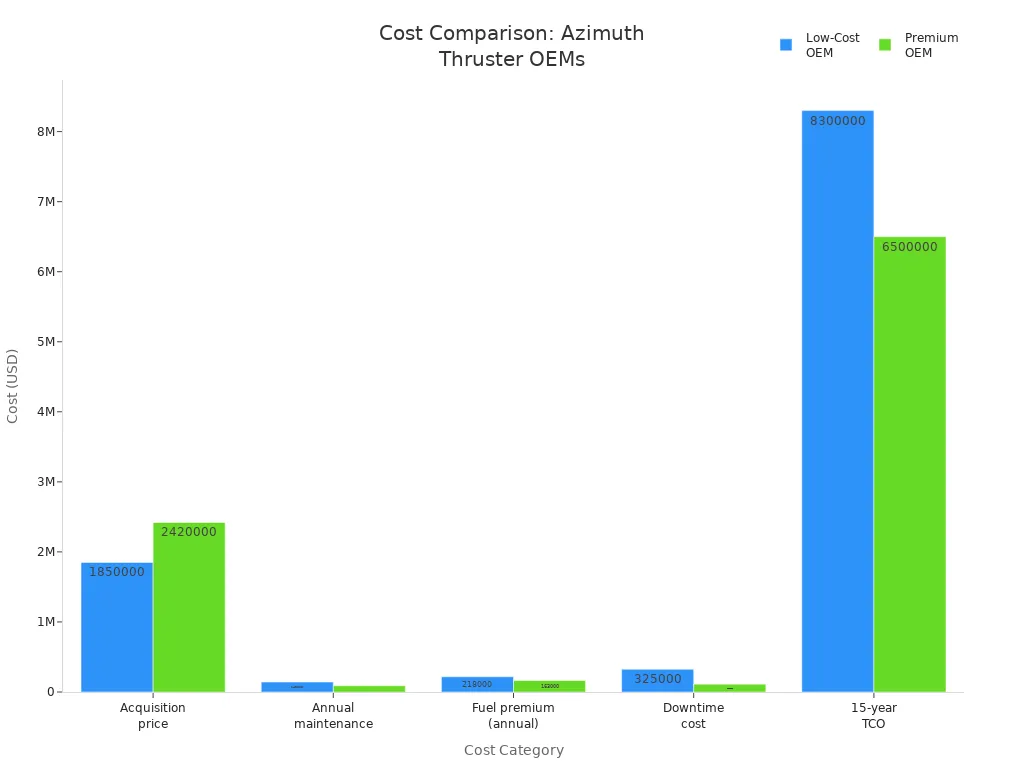
You need to balance your money with your vessel’s needs. Azimuth thrusters cost more at first, but you save money later with less fuel and maintenance. Traditional systems cost less to buy, but you may spend more on repairs and fuel. The chart below compares costs for low-cost and premium azimuth thruster options:
Cost Category | Low-Cost OEM | Premium OEM | Notes |
|---|---|---|---|
Acquisition price | $1.85M | $2.42M | Premium includes extended warranty and training |
Annual maintenance | $142,000 | $89,000 | Seal replacement and gearbox oil change intervals |
Fuel premium (annual) | $218,000 | $163,000 | Lower partial-load efficiency and friction losses |
Downtime cost (est.) | $325,000 | $112,000 | Based on charter rate × unplanned repair hours |
15-year TCO | $8.3M | $6.5M | Premium saves $1.8M despite higher initial cost |
You see that premium options save money over time, even if they cost more at first. You should look at total cost of ownership, not just the price to buy. Azimuth thrusters help you cut downtime and fuel costs, so they are a smart choice for many vessels.
You have to think about some important technical needs before picking a propulsion system. These needs change how your ship moves, how safe it is, and how well it works. You should make sure these needs fit your ship’s job and where it will go.
Here is a table that lists the main technical needs and what they mean for your ship:
Technical Requirement | Description |
|---|---|
Thrust Output (kN) | Shows how much push or pull your ship gets. You need the right amount for your ship’s weight and the water you travel in. |
Propeller Type | Fixed-pitch propellers are good for steady trips. Controllable-pitch propellers help you steer better but are harder to use. |
Rotation Speed & Response Time | Turning faster helps your ship react quickly. This is needed for holding position and sharp turns. |
Power Source Integration | You must check if the system works with your ship’s power. This is important for electric or hybrid ships. |
Dynamic Positioning Compatibility | Your system should work with DP Class 2 or 3. Good connections help your ship stay in one place. |
Redundancy Options | Two motors or more thrusters make your ship safer. You have a backup if one stops working. |
IP Rating & Sealing Standards | High IP ratings and strong cooling keep your system safe from water and heat. This matters for ships that work hard or in tough places. |
First, check thrust output. Heavy ships or ships in rough water need more power. Next, look at the propeller type. Fixed-pitch propellers are simple and strong. Controllable-pitch propellers let you move the blades for better steering. CPP gives you more choices, which helps in ports or when you need to turn fast.
Rotation speed and response time help your ship move quickly. Azimuth thrusters can spin all the way around, so you get quick moves. This helps with holding position and emergencies. Power source integration is key for electric or hybrid ships. Your system must work with your ship’s power setup.
Dynamic positioning compatibility lets your ship stay still without anchors. Your system should connect with DP controls and sensors. Redundancy options make your ship safer. If one thruster fails, another can work. This keeps your ship moving and your crew safe.
IP rating and sealing standards keep your system safe from water and heat. You need high protection for ships in harsh places. Good cooling helps your system last longer.
Tip: Always pick technical needs that match your ship’s job. You get better safety, performance, and trust when you choose the right system.
Azimuth propulsion & thrusters are best for ships that need great turning and efficiency. Traditional systems work well for cargo ships and tankers that travel steady routes. The right system depends on your ship, how you use it, and your money. Deyuanmarine gives certified azimuth thrusters and expert help. Think about these things before you choose:
Make sure your ship fits the system.
Look at your routes and weather.
Check how well the system works and lasts.
Think about costs over time.
Pick suppliers who know their stuff.
You choose the best system when you match your ship’s needs with the right option.
An azimuth thruster is a device that helps ships move. It can turn all the way around in a full circle. This means you can steer your ship any way you want. You get great control and can turn easily.
Tugs, ferries, and offshore supply ships use azimuth thrusters the most. These ships need to move exactly where they want. Azimuth thrusters help them dock, turn, and stay in one spot.
Azimuth thrusters cost more when you buy them. But you save money later on fuel and repairs. You also get better control and use less energy.
Deyuan Marine azimuth thrusters have certificates from ABS, LR, DNV, GL, BV, RINA, and BKI. You can trust that they are safe and good quality.
You can add azimuth thrusters to many ships. Deyuan Marine has different ways to install them. You should check if your ship has enough space and the right setup first.
Think about your ship’s size, what it does, and your budget. Azimuth thrusters are best for ships that need to turn and move in small spaces. Traditional systems are good for ships that go straight for a long time.
You get help from Deyuan Marine’s sales and engineering teams. They will help you pick the best system for your ship.