 English
  |
Product Description
Tanker Rail Floating Hose
Product Introduction:
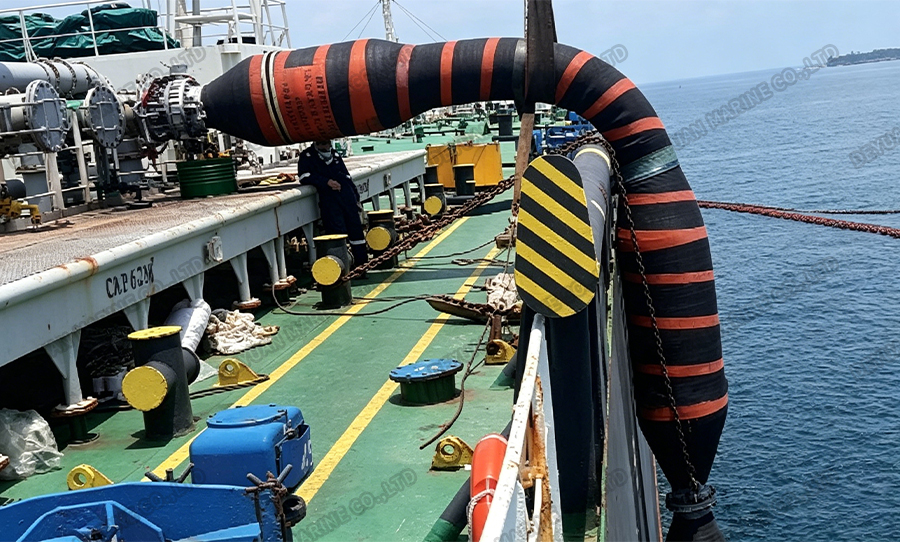
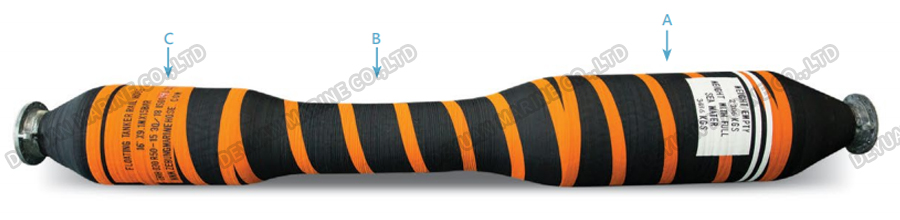
Tanker rail floating hose's buoyancy is relatively low. Its larger end rests on the railings, connecting to the tanker manifold, while the other end connects to the tail hose outside the ship. The tanker end is much more floatable. This design provides enhanced buoyancy for valves and coupling devices, thereby protecting the equipment.
Main Body/Inner Tube: Smooth, oil-resistant, fuel-resistant, seamless and extruded Acrylonitrile-Butadiene Rubber (NBR).
Safety Liner: Special construction to prevent defects or damage caused by accidental tearing or superficial damage of the main inner liner.
Reinforcement: Multiple plies of high-strength textile cord, with one embedded spiral steel wire in the main body.
Cover: Smooth black synthetic rubber, oil-resistant.
Single Carcass & Double Carcass: Available.
Flotation Material: Closed-cell foam.
Outer Cover: Smooth black synthetic rubber, resistant to abrasion, oil, seawater, and sunlight. Spiral orange stripe.
End Fittings: Terminal connections built-in during manufacturing. ASME B16.5 Class 150 or Class 300, weld neck, flat face or raised face, as required.
Testing: All tests conducted in accordance with GMPHOM 2009 and customer specifications.
Application: Floating offshore oil hoses are designed for transporting crude oil and liquid petroleum products between loading/unloading vessels in offshore mooring systems.
Technical Specifications:
| Nominal inner diameter (mm) | Weight in air(kg) | Outer diameter (mm) | Minimum bending radius | ||||
| 9.1m | 10.7m | 12.2m | A | B | C | m | |
| 150(6”) | 524 | 576 | 628 | 500 | 290 | 440 | 0.6(2.0') |
| 200(8”) | 726 | 817 | 908 | 560 | 350 | 530 | 0.8(2.7') |
| 250(10”) | 931 | 1037 | 1143 | 690 | 420 | 630 | 1.0(3.3') |
| 300(12”) | 1091 | 1225 | 1359 | 810 | 490 | 640 | 1.2(4.0') |
| 400(16”) | 1650 | 1839 | 2028 | 1000 | 580 | 840 | 1.6(5.3') |
| 500(20”) | 2200 | 2550 | 2800 | 1100 | 720 | 1000 | 2.0(6.7') |
Key Features:
1.Connect the manifold and the tail hose
2.Lifting lugs shall withstand loads with minimum breaking load: 12" = 100 KN, 16" = 150 KN, 20" = 200 KN.
3.Rated Working Pressure (RWP): 21 bar.
4.Minimum Reserve Buoyancy: 20% or according to customer requirements.
5.Electrical Continuity: Electrically continuous or discontinuous.
6.Leak Detection System: In the event of main carcass failure, the detector responds to the leak, alerting the operator to remove the damaged hose, thereby avoiding economic loss and environmental pollution.
7.Specifications can be designed according to customer requirements.