 English
  |
Product Description
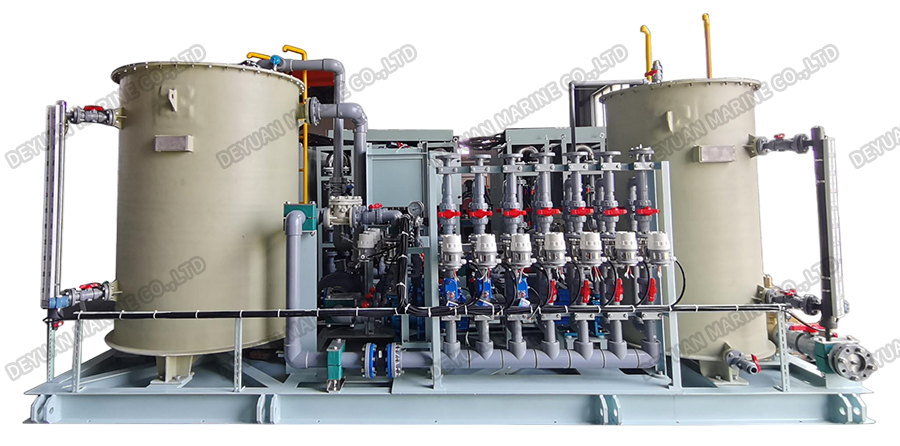
RDDJ-400 Electrolysis Of Seawater Anti-fouling System (Skid)
Product Introduction:
The seawater passes through the electrolytic cell, where it is subjected to a DC current, to make electrolytic reactions.Then the chlorine is produced on anode and hypochlorite on cathode. After that, the hypochlorite and chlorine reacts directly between anode and cathode to produce new state hypochlorite.This reacted material has strong oxidization. Apply it to cooling water system with a concentration of 0.01mg/L, the seawater will now contain a trace residual sufficient to prevent the attachment and growth of marine organisms,thus keeping all seawater parts free from fouling.
Key Features:
1.Complete Skid-Mounted Assembly
All components integrated on a single steel base frame – one lift, one installation, one connection point.
2.No Heavy Metal Release
Zero copper, zinc, or other metals discharged – fully compliant with IMO AFS Convention, EU BPR, and US VGP.
3.On-Demand Biocide Generation
Produces sodium hypochlorite continuously from seawater – no chemical purchase, storage, or handling.
4.Factory Pre-Assembled & Pre-Tested
Hydraulic and electrical testing completed before delivery – reduces on-site commissioning time by up to 80%.
5.Automatic Flow-Proportional Control
Microprocessor-controlled system adjusts chlorine output based on seawater flow rate, temperature, and salinity.
6.Compact, Space-Saving Layout
Optimized component arrangement minimizes footprint – fits through standard hatches and into tight engine rooms.
7.Corrosion-Resistant Construction
Electrolytic cell with platinized titanium or MMO coated anodes; piping in UPVC, CPVC, titanium, or 316L stainless steel.
8.Easy Maintenance Access
Skid design includes service clearance around all components; hinged panels and quick-disconnect fittings available.
9.Optional Hydrogen Degasser
Safely removes and vents hydrogen gas generated during electrolysis – critical for enclosed spaces.
10.Remote Monitoring Ready
Standard 4-20 mA outputs and alarm relays for integration with ship's automation or bridge control system.